Unlock Inorganic Chemistry: Memorize Periodic Table Trends!
Table of Contents
Inorganic chemistry can often feel like a maze of elements and their behaviors. However, understanding the periodic table is your compass, and its trends are the clear pathways. Mastering these trends isn't just about rote memorization; it's about building a foundational understanding that will demystify countless chemical reactions and properties. Let's dive into the most effective ways to memorize and truly understand periodic table trends.
Why Periodic Trends Are Your Best Friend
Periodic trends explain *why* elements behave the way they do. From reactivity to bond formation, these patterns dictate the fundamental properties of atoms. Grasping them is crucial for predicting chemical outcomes, understanding molecular structures, and excelling in your chemistry studies.
The Core Trends and How They Flow
Before we memorize, let's briefly review the key trends. Remember that most trends are driven by two main factors: Effective Nuclear Charge (Zeff), which increases across a period, and the number of Electron Shells, which increases down a group.
1. Atomic Radius (Size of the Atom)
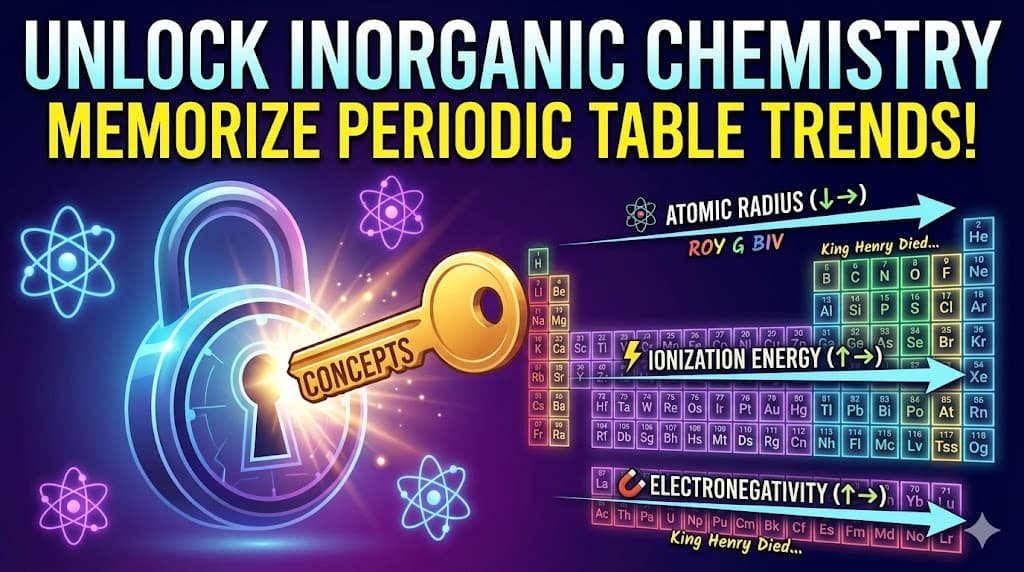
- Trend: Decreases across a period, Increases down a group.
- Why: Across a period, Zeff increases, pulling electrons closer. Down a group, more electron shells are added, making the atom larger.
- Memory Tip: Imagine blowing up a balloon (adding shells, getting bigger) as you go down. As you move across, more protons are added to the nucleus, pulling the same number of shells tighter, making the balloon shrink.
2. Ionization Energy (Energy to Remove an Electron)
- Trend: Increases across a period, Decreases down a group.
- Why: Across a period, Zeff increases, holding electrons more tightly. Down a group, outer electrons are further from the nucleus and shielded by inner electrons, making them easier to remove.
- Memory Tip: Think of a strong magnet (nucleus) holding onto marbles (electrons). Stronger magnet (higher Zeff) = harder to pull a marble (higher IE). If the marbles are further away, they're easier to pluck off.
3. Electron Affinity (Energy Change When an Electron is Added)
- Trend (generally more negative/exothermic): Increases across a period, Decreases down a group.
- Why: Across a period, atoms are closer to a stable octet, so they 'want' an electron more strongly. Down a group, the added electron is further from the nucleus, experiencing less attraction.
- Memory Tip: Similar to IE, but in reverse. Atoms across a period are 'greedy' for an electron to complete their shell.
4. Electronegativity (Ability to Attract Electrons in a Bond)
- Trend: Increases across a period, Decreases down a group.
- Why: Across a period, Zeff increases and atoms are closer to a stable octet, leading to a stronger pull on bonding electrons. Down a group, outer electrons are further away and shielded, reducing the pull.
- Memory Tip: Fluorine (F) is the most electronegative element, sitting at the top-right (excluding noble gases). Think of it as the 'electron hog' of the periodic table. The closer an element is to Fluorine, the more electronegative it is.
5. Metallic Character (Tendency to Lose Electrons)
- Trend: Decreases across a period, Increases down a group.
- Why: Across a period, atoms tend to gain electrons (become non-metallic). Down a group, electrons are easier to lose due to increased atomic radius and shielding.
- Memory Tip: Metals are found on the left and bottom of the table. They are 'loose' with their electrons. Francium (Fr) at the bottom-left is the most metallic element.
Effective Strategies for Lasting Retention
- Conceptual Understanding is King: Don't just memorize arrows. Understand *why* each trend occurs based on Zeff, shielding, and electron shells. This prevents confusion when trends seemingly reverse (e.g., noble gases for EA).
- Visualize with Your Own Table: Draw a blank periodic table. Use different colored arrows to represent each trend. Label the reasons next to the arrows. This active learning creates strong visual cues.

- Mnemonic Devices:
- Atomic Radius: Think 'DR. PAN' (Down-Radius, Period-Across-Narrower).
- General Trends: For Electronegativity, Ionization Energy, and Electron Affinity (mostly): they generally Increase Up and to the Right (towards Fluorine). Atomic Radius and Metallic Character generally Increase Down and to the Left (towards Francium).
- Practice Problems Relentlessly: Apply the trends to compare elements. "Which has a larger atomic radius, Na or Cl?" "Which has higher ionization energy, O or S?" Each correct answer reinforces the trend.
- Flashcards: Create flashcards for each trend. On one side, write the trend name (e.g., "Atomic Radius"). On the other, write the direction (e.g., "Decreases across period, Increases down group") and a brief 'why'.
- Teach Someone Else: Explaining the trends to a friend, classmate, or even an imaginary audience solidifies your own understanding and highlights any gaps in your knowledge.
Conclusion: Consistency is Your Ally
Memorizing periodic table trends takes consistent effort, but it's one of the most rewarding investments you can make in your chemistry journey. By combining conceptual understanding with visual aids, mnemonics, and plenty of practice, you'll not only remember these trends but truly comprehend the beautiful logic of the periodic table. Happy studying!