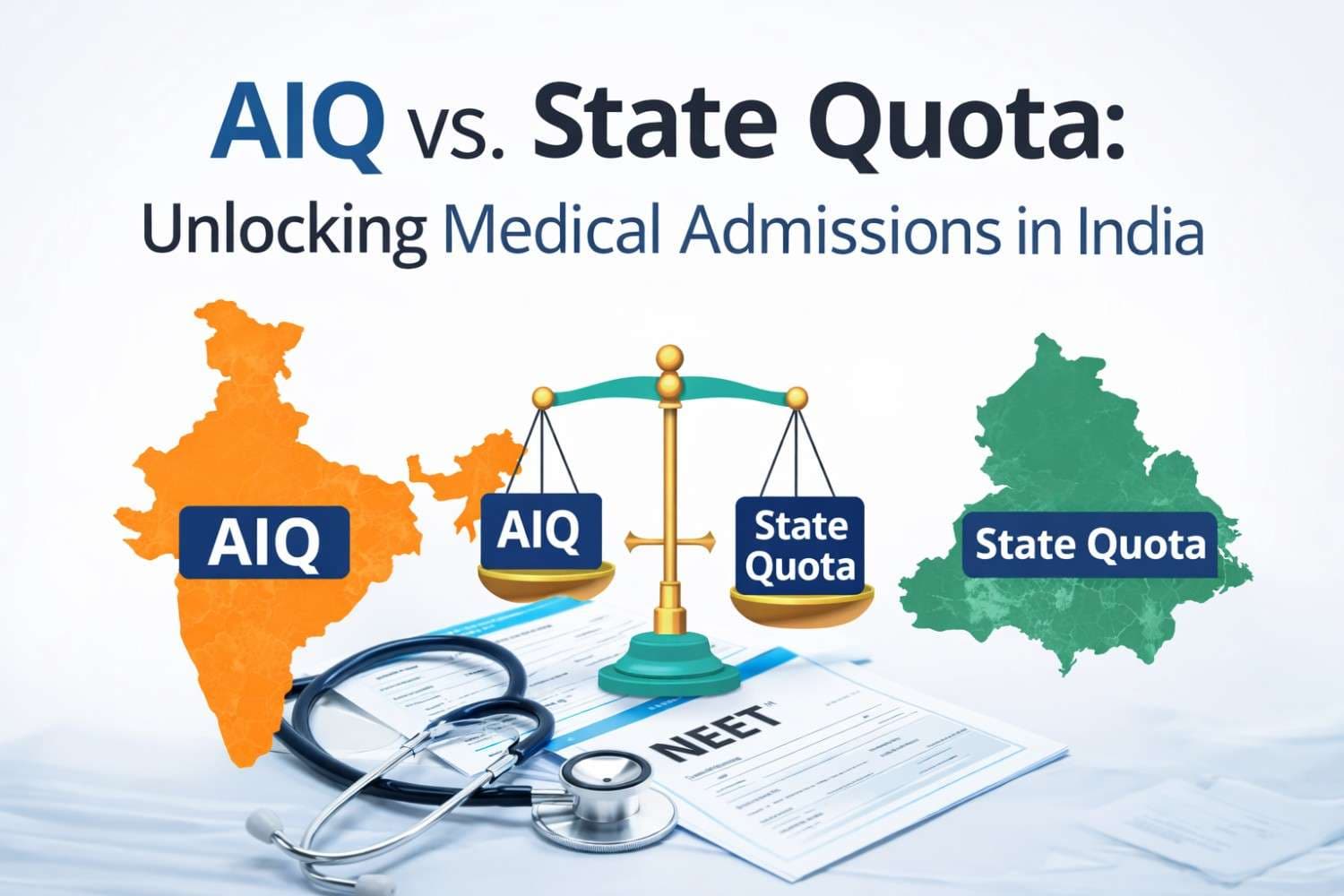
AIQ vs. State Quota: Unlocking Medical Admissions in India
Table of Contents
Navigating medical college admissions in India can often feel like solving a complex puzzle. With lakhs of aspirants competing for a limited number of seats, understanding the different reservation categories and admission pathways is paramount. Two of the most significant categories that students encounter are the All India Quota (AIQ) and the State Quota. Grasping the nuances of each can significantly impact your admission strategy and chances.
What is the All India Quota (AIQ)?
The All India Quota (AIQ) is a scheme introduced by the Supreme Court of India to ensure that students from all states have an opportunity to study medicine in any government medical college across the country. Here's a breakdown:
- Percentage of Seats: The AIQ comprises 15% of all undergraduate (MBBS/BDS) seats in government medical and dental colleges nationwide. For postgraduate (MD/MS/MDS) courses, this quota is 50% of the seats in government institutions.
- Eligibility: Any Indian citizen, regardless of their state of domicile, is eligible to apply for seats under the AIQ. (Historically, Jammu & Kashmir opted out, but recent changes have integrated it more fully into the national system).
- Counseling Authority: The Medical Counselling Committee (MCC), under the Directorate General of Health Services (DGHS), Ministry of Health & Family Welfare, Government of India, conducts the counseling for AIQ seats.
- Key Features: It allows for broader college choice and gives high-ranking students access to prestigious institutions across different states. However, due to its pan-India nature, competition is extremely high.
What is the State Quota?
The State Quota, as the name suggests, is specific to individual states and caters primarily to residents of that state. It forms the bulk of the available seats in government medical colleges within a particular state.
- Percentage of Seats: After the 15% AIQ deduction, the remaining 85% of undergraduate (MBBS/BDS) seats in government medical and dental colleges within a state fall under the State Quota. Similarly, for postgraduate courses, 50% of seats are reserved under the State Quota. This also includes seats in private medical colleges located within that state.
- Eligibility: To be eligible for the State Quota, candidates must fulfill the domicile criteria of that specific state, which typically involves having resided in the state for a certain period or having completed schooling from institutions within the state.
- Counseling Authority: Each state's respective medical admission authority (e.g., Directorate of Medical Education, State Counseling Board) conducts the counseling for State Quota seats.
- Key Features: Competition is generally lower compared to the AIQ for domiciled candidates. However, the choice of colleges is limited to those within the state. State-specific reservation policies (for OBC, SC, ST, EWS, PwD, etc.) apply under this quota.
Key Differences at a Glance
| FeatureAll India Quota (AIQ)State Quota | ||
| Percentage of Seats (UG) | 15% of government seats | 85% of government seats + private college seats |
| Eligibility | All Indian citizens | Domicile of the specific state |
| Counseling Body | Medical Counselling Committee (MCC) | Respective State Counselling Authority |
| College Choice | Pan-India | Limited to colleges within the domicile state |
| Competition Level | Very High | Comparatively Lower (for residents) |
| Reservation Policy | Central Government reservation policies | State-specific reservation policies |
Impact on Admissions and Strategy
Understanding these two quotas is vital for a strategic approach to medical admissions:
- Dual Opportunity: Most candidates apply for both AIQ and their respective State Quota, effectively getting two chances at securing a seat.
- Prioritization: High-ranking students might initially aim for top colleges via AIQ, while also keeping their state-specific options open. Students with mid-range scores often find better opportunities through their State Quota due to less competition.
- Domicile Importance: Your state of domicile is a crucial factor. Without it, you are generally ineligible for the State Qu Quota seats in any state.
- Strategic Choices: Counseling involves careful decision-making. If you secure a seat in the first round of AIQ counseling, you might choose to upgrade in subsequent rounds or hold onto it while exploring better options in your State Quota.
Conclusion
The All India Quota and State Quota are fundamental pillars of medical admissions in India, each designed to balance national access with regional representation. As an aspirant, thoroughly understanding the eligibility criteria, counseling process, and competition levels for both is essential. By making informed choices, you can significantly enhance your prospects of securing a coveted seat in a medical college and embarking on your journey to becoming a healthcare professional.