
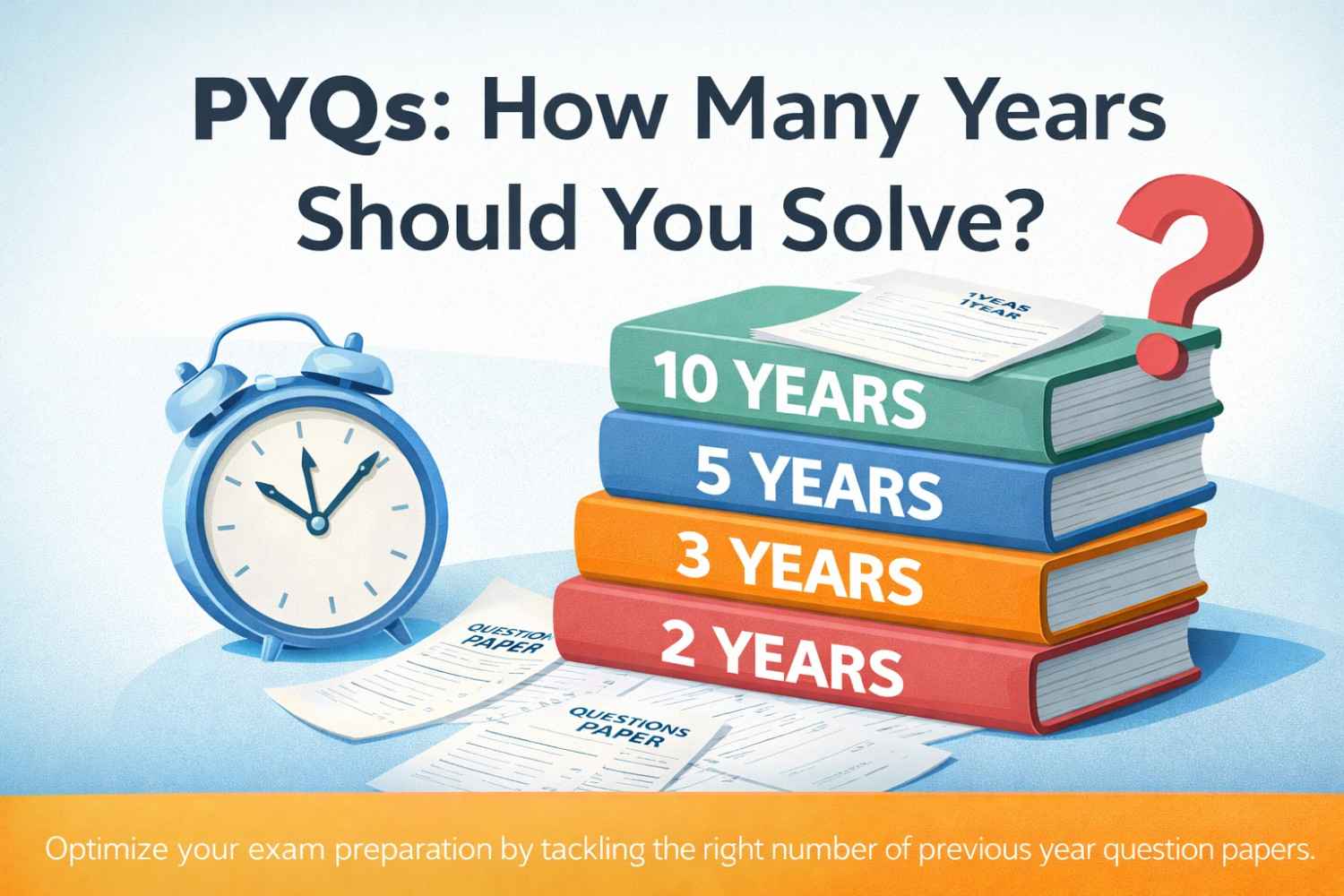
PYQs: How Many Years Should You Solve?
Table of Contents
Previous Year Questions (PYQs) are the gold standard of exam preparation. They offer invaluable insights into the exam pattern, important topics, question types, and the overall difficulty level. But a common dilemma for aspirants is: How many years of PYQs should I solve? Is it 5 years, 10 years, or even more?
The General Recommendation: A Starting Point
While there's no one-size-fits-all answer, a widely accepted starting point is to solve at least the last 5-7 years of PYQs. For highly competitive exams or those with a vast and stable syllabus, extending this to 10 years can be immensely beneficial.
Factors Influencing the Number of Years
The 'ideal' number of years isn't fixed; it depends on several crucial factors:
1. The Nature of the Exam
- Exams with Stable Syllabi/Patterns: For exams like many engineering, medical, or civil service entrance tests where core concepts remain largely unchanged, solving more years (up to 10-15) can be highly advantageous. Older papers still hold significant relevance.
- Exams with Dynamic Syllabi/Patterns: If the exam frequently undergoes significant syllabus changes, pattern shifts, or places heavy emphasis on current affairs, focusing more intensely on the most recent 3-5 years might be more productive. Older papers might contain outdated information or question styles.
2. Subject Matter
- Static Subjects: For subjects like History, basic Math, Physics, Chemistry, or fundamental concepts in any field, questions from older papers are often still pertinent and excellent for practice.
- Dynamic Subjects/Current Affairs: For subjects heavily reliant on current events, economics, or rapidly evolving technology, older PYQs might primarily serve to understand the *type* of questions asked, rather than the specific content. You'd still need to update your knowledge.
3. Your Preparation Level and Time Availability
- Early Stages / Less Time: If you're just starting out or have limited time before the exam, prioritize the most recent 3-5 years to get a foundational understanding of the current trend.
- Advanced Stages / Ample Time: If you've covered the syllabus and have sufficient time, gradually expand your PYQ solving to 7-10 years or even more to gain a deeper understanding and practice a wider range of questions.
4. Availability of Resources
Sometimes, the number of readily available and reliable PYQs dictates how many you can solve. Aim for quality sources that provide solutions and explanations.
More Important Than 'How Many': 'How You Solve'
Simply solving numerous PYQs without a strategy is less effective. Focus on the quality of your analysis:
- Identify Trends: What topics are frequently asked? Are there recurring themes?
- Understand Question Types: Differentiate between direct, analytical, application-based, and memory-based questions.
- Analyze Options: Even for incorrect options, try to understand why they are wrong. This deepens your knowledge.
- Time Management: Practice solving papers under exam conditions to improve speed and accuracy.
- Spot Weaknesses: PYQs are excellent diagnostic tools. They reveal your strong and weak areas, allowing you to focus your revision effectively.
Conclusion
As a rule of thumb, target 5-7 years for a solid base, extending to 10 years for comprehensive preparation, especially for stable exams. However, always prioritize quality over quantity. A thorough analysis of 5 years' worth of papers is far more valuable than a superficial glance at 15 years. Use PYQs not just to test yourself, but to learn, strategize, and refine your approach. Good luck!