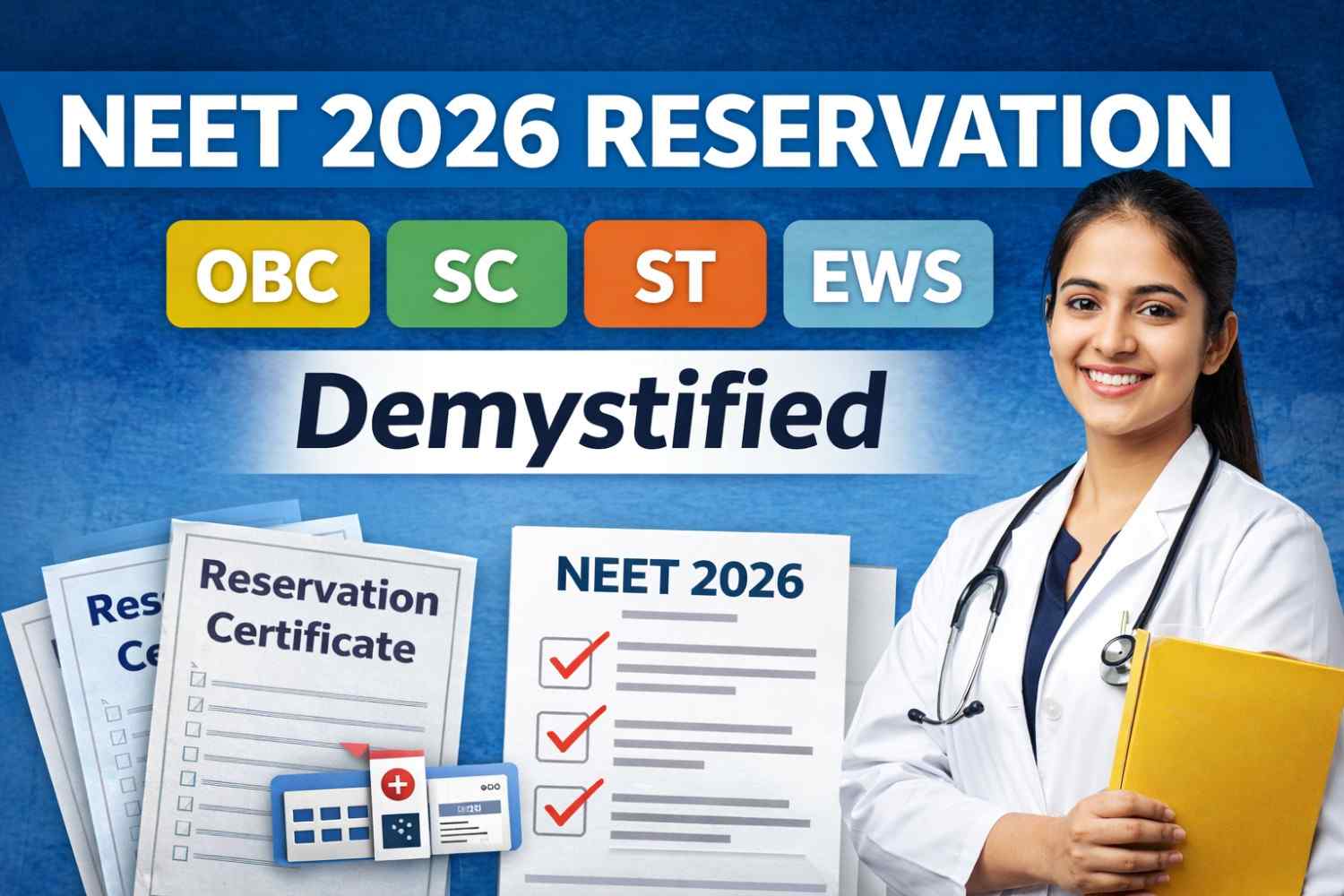
NEET 2026 Reservation: OBC, SC, ST, EWS Demystified
Table of Contents
Aspiring medical students eyeing NEET 2026 must not only focus on their studies but also thoroughly understand the intricate reservation criteria. These provisions play a crucial role in determining admission chances to prestigious medical and dental colleges across India. This blog post aims to demystify the reservation policies for OBC, SC, ST, and EWS categories, helping you prepare effectively.
Understanding Reservation in NEET
Reservation in medical admissions is a constitutional provision designed to promote social equity and provide opportunities for historically disadvantaged communities. For NEET, seats are broadly divided into All India Quota (AIQ) and State Quota seats, each with specific reservation policies. The National Testing Agency (NTA), which conducts NEET, adheres to the Government of India's reservation policies for the 15% AIQ seats.
1. OBC (Other Backward Classes) Reservation
The reservation for OBC candidates in the All India Quota (AIQ) is 27%. Key points to note:
- Non-Creamy Layer (NCL): Only candidates belonging to the 'Non-Creamy Layer' of OBCs are eligible for this reservation. The 'Creamy Layer' consists of individuals and families who have achieved a certain economic and social status, and they are treated as part of the General category.
- Central List: Candidates must belong to the Central List of OBCs. A community recognized as OBC by a state government may not necessarily be on the Central List.
- Certificate: A valid OBC-NCL certificate issued by a competent authority, based on the income criteria of the financial year preceding the year of application, is mandatory. It typically needs to be issued on or after April 1st of the admission year.
2. SC (Scheduled Castes) Reservation
Scheduled Castes candidates are provided with 15% reservation in the All India Quota. Important aspects include:
- Eligibility: Candidates must belong to a caste listed in the Schedule Castes list of the Government of India.
- Certificate: A valid SC certificate issued by a competent authority is required. This certificate typically has no expiry date but should be in the prescribed format.
3. ST (Scheduled Tribes) Reservation
Scheduled Tribes candidates are entitled to 7.5% reservation in the All India Quota. Key considerations:
- Eligibility: Candidates must belong to a tribe listed in the Scheduled Tribes list of the Government of India.
- Certificate: A valid ST certificate from a competent authority is essential. Similar to SC certificates, it usually does not have an expiry date but must be in the correct format.
4. EWS (Economically Weaker Sections) Reservation
The EWS category, introduced more recently, provides 10% reservation for candidates not covered under existing reservations for SC, ST, and OBCs. To be eligible:
- Income Criteria: The candidate's family annual gross income must be below Rs. 8 lakhs (Rupees Eight Lakhs only) from all sources.
- Asset Criteria: The family should not own any of the following assets:
- 5 acres of agricultural land and above.
- A residential flat of 1000 sq. ft. and above.
- A residential plot of 100 sq. yards and above in notified municipalities.
- A residential plot of 200 sq. yards and above in areas other than notified municipalities.
- Definition of 'Family': Includes the person who seeks the benefit of reservation, his/her parents, siblings below the age of 18, and his/her spouse and children below the age of 18.
- Certificate: A valid Income and Asset Certificate issued by a competent authority (e.g., Tehsildar/Collector/DM) is required. This certificate is usually valid for one financial year and needs to be obtained fresh for the admission year.
PwD (Persons with Disabilities) Reservation
It's important to note a 5% horizontal reservation for Persons with Disabilities (PwD) across all categories (General, OBC, SC, ST, EWS). This means that 5% of seats within each category are reserved for PwD candidates belonging to that category, provided they meet the disability criteria specified by the Medical Council of India (MCI)/National Medical Commission (NMC).
Important Considerations for NEET 2026
- All India Quota vs. State Quota: The above percentages apply to the 15% All India Quota seats. State Quota seats (85%) have reservation policies determined by the respective state governments, which may vary.
- Validity of Certificates: Ensure all caste/category certificates are valid, issued by the appropriate authority, and conform to the prescribed format as per the latest NTA/MCC (Medical Counseling Committee) guidelines for NEET 2026. For OBC-NCL and EWS, certificates often have an annual validity and must be updated.
- Self-Declaration: While applying for NEET, you will declare your category. However, the original documents will be scrutinised during counselling and admission. Any discrepancy can lead to disqualification.
- Stay Updated: The exact guidelines and formats are released with the official NEET 2026 information bulletin. Always refer to the latest official notifications from NTA and MCC for any updates or changes.
Conclusion
Understanding the NEET 2026 reservation criteria is as crucial as preparing for the exam itself. Ensure you belong to the correct category, meet all eligibility conditions, and have valid, up-to-date certificates well in advance. Proper documentation and awareness will prevent last-minute hassles and secure your rightful place in the competitive world of medical admissions.