
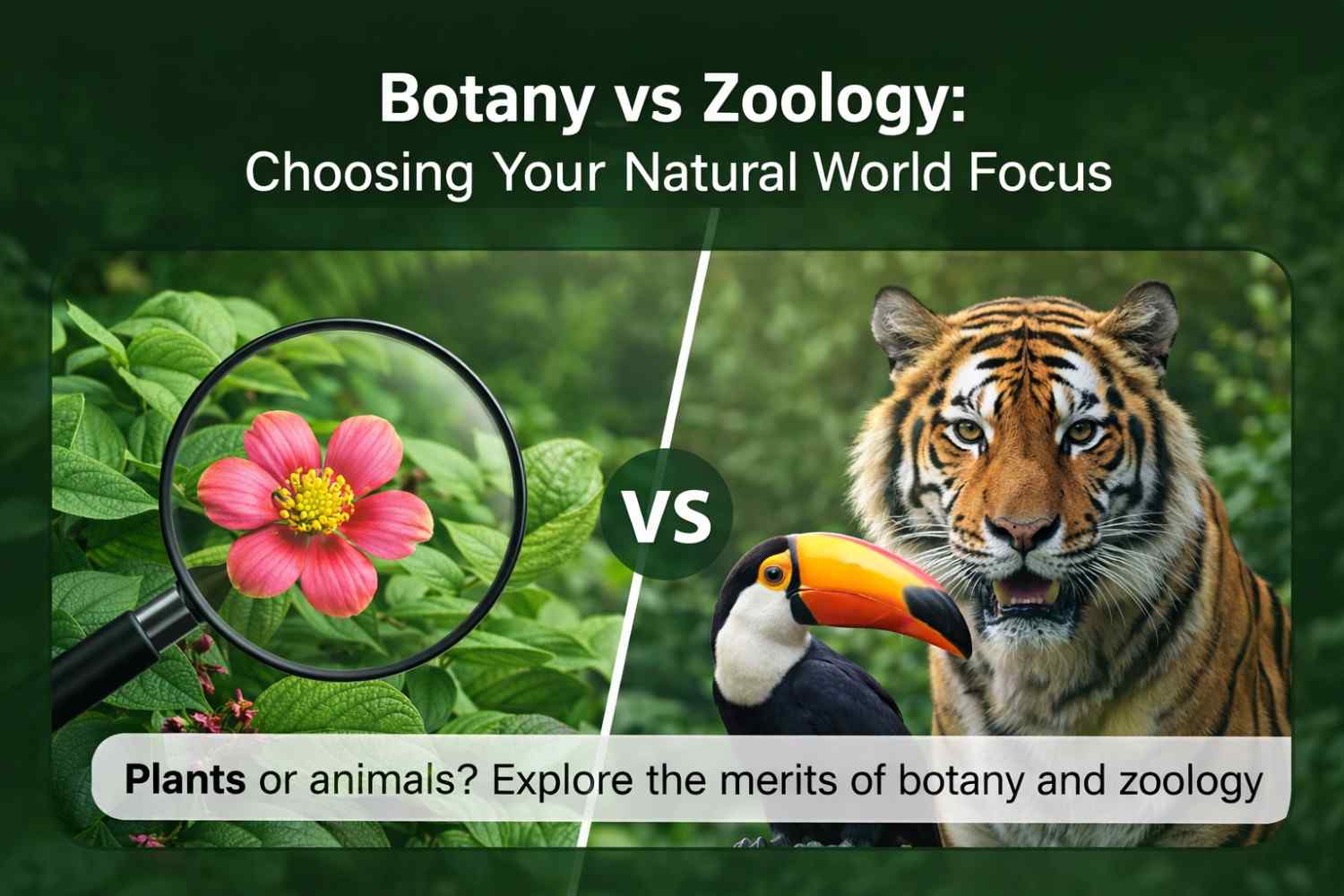
Botany vs Zoology: Choosing Your Natural World Focus
Table of Contents
The natural world is vast and endlessly fascinating, often sparking a desire to understand its intricate workings. When pursuing a deeper knowledge of biology, two major branches frequently come to the fore: Botany, the study of plants, and Zoology, the study of animals. But when faced with the question of where to focus more, how do you decide?
Understanding the Fields
Botany explores the life of plants, from microscopic algae to towering redwood trees. Botanists investigate plant structure, growth, reproduction, metabolism, diseases, chemical properties, and evolutionary relationships. It encompasses areas like plant physiology, ecology, genetics, and ethnobotany.
Zoology, on the other hand, is dedicated to the study of animals. Zoologists examine animal behavior, anatomy, physiology, evolution, classification, and distribution. Specializations include mammology, ornithology, entomology, marine biology, and primatology, among many others.
The Critical Importance of Each
It's crucial to acknowledge that neither field is inherently 'more' important than the other. Both are fundamental to understanding life on Earth and addressing global challenges.
Why Botany is Indispensable:
- Foundation of Life: Plants are primary producers, forming the base of nearly all food webs through photosynthesis. Without plants, most animal life, including humans, would not exist.
- Oxygen Production: They release the oxygen we breathe.
- Climate Regulation: Plants absorb carbon dioxide, playing a vital role in mitigating climate change.
- Medicine and Pharmaceuticals: A vast number of modern medicines are derived from plants (e.g., aspirin, taxol, quinine).
- Food Security: Agriculture is applied botany, essential for feeding the global population.
- Ecosystem Health: Plants prevent soil erosion, purify water, and create habitats.
Why Zoology is Indispensable:
- Biodiversity Understanding: Animals represent a staggering portion of Earth's biodiversity, and their study helps us understand complex ecosystems.
- Human Health: Research on animals contributes to understanding human physiology, disease (e.g., immunology, neuroscience), and developing medical treatments.
- Ecological Balance: Animals play crucial roles as pollinators, seed dispersers, predators, and decomposers, maintaining ecosystem health.
- Behavioral Insights: Studying animal behavior offers insights into evolution, psychology, and even human social structures.
- Conservation: Understanding animal populations and their threats is key to protecting endangered species and preserving natural habitats.
Where to Focus More: A Personal and Practical Perspective
The idea of focusing 'more' on one over the other often depends on individual passion, career aspirations, and the specific problems one aims to solve.
- Personal Interest: The most significant factor should be your genuine curiosity. Are you captivated by the silent, intricate processes of a plant cell, or the dynamic behaviors and complex interactions of animal species? Following your passion will lead to greater engagement and success.
- Career Paths: Both fields offer diverse opportunities. Botanists might work in agriculture, horticulture, forestry, pharmaceutical research, environmental consulting, conservation, or academic research. Zoologists find roles in veterinary medicine, wildlife management, marine biology, ecological restoration, museum curation, biomedical research, and education.
- Interdisciplinary Nature: Increasingly, the most impactful work bridges both fields. Ecologists, for instance, must understand both plant communities and the animals that interact with them. Conservation efforts often involve protecting both plant habitats and the animal species within them. Climate change research necessitates understanding how both flora and fauna respond to environmental shifts.
- Global Challenges: If your goal is to tackle food security, botany might seem more direct. If it's combating zoonotic diseases, zoology takes precedence. However, both are ultimately interconnected in solving overarching issues like biodiversity loss and ecosystem collapse.
Conclusion
Ultimately, there is no single answer to where one should focus 'more.' Both Botany and Zoology are profoundly vital and contribute uniquely to our understanding and stewardship of the planet. Rather than choosing one as superior, consider them two essential lenses through which to view the magnificent tapestry of life. Your decision should be guided by your innate curiosity, the specific questions you wish to answer, and the impact you aspire to make. The natural world thrives on the delicate balance and intricate connections between plants and animals, and so too does our understanding of it.