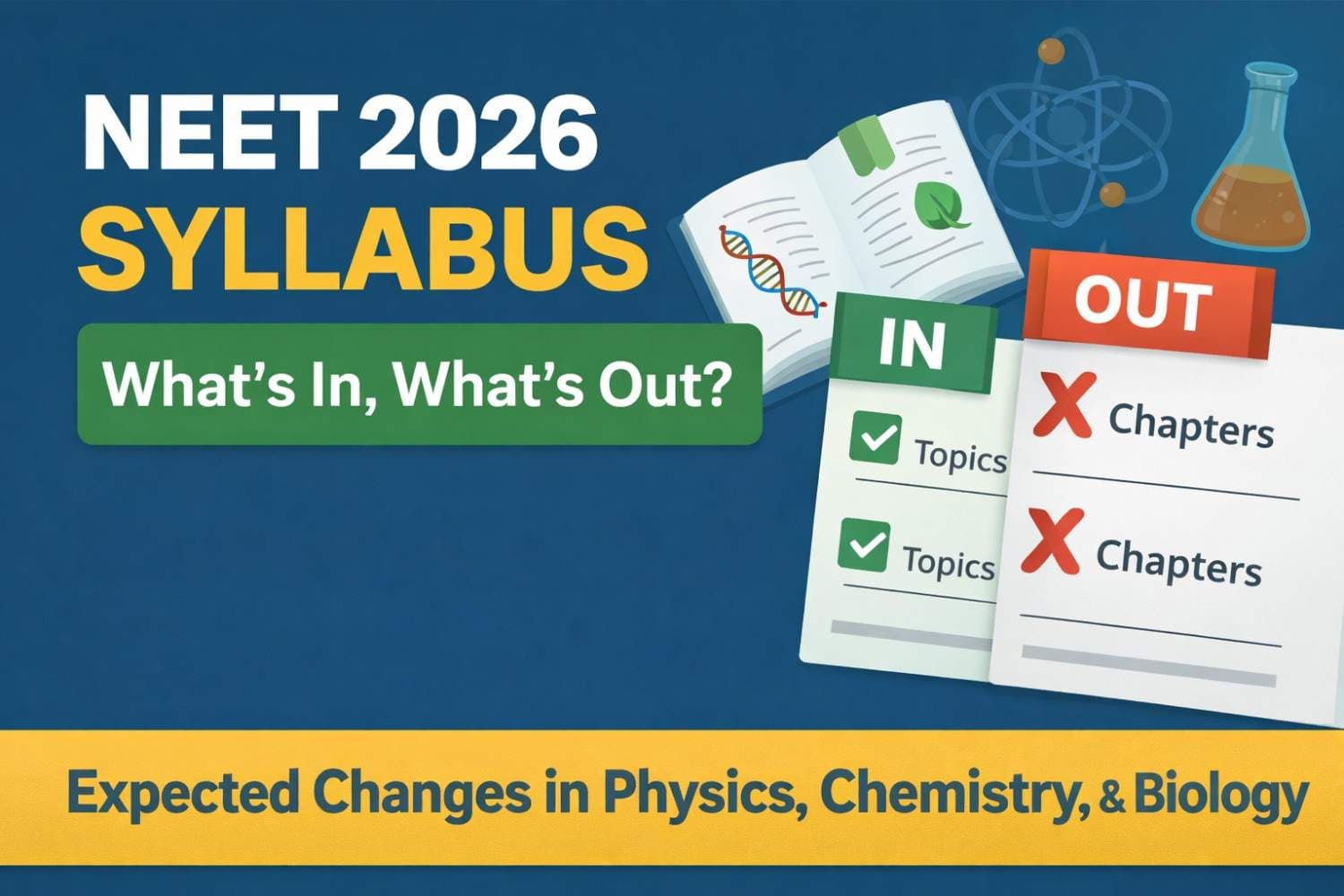
NEET 2026 Syllabus: What's In, What's Out?
Table of Contents
Aspirants eyeing the National Eligibility cum Entrance Test (NEET) in 2026 are already keen to understand the syllabus landscape. With the dynamic nature of education and periodic updates, staying informed about what's in and what's out is crucial for effective preparation. While official notifications for NEET 2026 are still some time away, the recent rationalization of NCERT textbooks provides a strong indicator of the direction the NEET syllabus is likely to take.
The Driving Force: NCERT Rationalization
The National Council of Educational Research and Training (NCERT) has undertaken a significant rationalization of its textbooks across various subjects, aiming to reduce the burden on students and focus on core concepts. Since NEET largely draws its syllabus from NCERT Class 11th and 12th content, these changes directly impact the medical entrance exam.
Expected Reduced Chapters & Topics
Based on the rationalized NCERT syllabi, here's a general overview of chapters and topics that are likely to be removed or significantly reduced from the NEET 2026 curriculum:
Physics: Less is More
- Physical World: Often removed as it's an introductory chapter.
- Units & Measurement: Some advanced topics or specific error analysis might be trimmed.
- Thermodynamics: Detailed discussions on heat engines and refrigerators might be omitted.
- Waves: The Doppler Effect might see reduced emphasis or exclusion.
- Communication Systems: Often a complete deletion due to its specialized nature.
Chemistry: Streamlined Concepts
- Solid State: This entire chapter has often been removed.
- Surface Chemistry: Another chapter frequently targeted for removal.
- General Principles and Processes of Isolation of Elements (Metallurgy): Expected to be removed.
- p-Block Elements: Extensive details about individual elements (especially Group 15-18) are often reduced, focusing on general trends.
- Polymers: Frequently removed as a whole chapter.
- Chemistry in Everyday Life: Often completely omitted.
- Environmental Chemistry: May see significant reduction or removal of specific topics.
Biology: Core Principles Emphasized
- Reproduction in Organisms: Often removed as a standalone chapter, with core concepts integrated elsewhere.
- Digestion and Absorption: Expected to be removed.
- Transport in Plants: Likely to be removed.
- Mineral Nutrition: Expected to be removed.
- Strategies for Enhancement in Food Production: Often removed.
- Organisms and Populations: Specific sections may be reduced or merged.
- Environmental Issues: Specific details might be rationalized.
Note: This list is based on the current trend of NCERT rationalization. Always refer to the official NEET 2026 information bulletin once released for definitive syllabus details.
Are There New Additions?
Genuine 'new additions' in the NEET syllabus are less common than reductions. However, what sometimes appears as 'new' is often:
- Clarification of Scope: Certain topics that were ambiguously defined might now have clearer boundaries.
- Re-emphasis on Core Concepts: With reductions, the focus on fundamental principles within the remaining chapters might intensify.
- Practical Chemistry/Biology: There might be a greater emphasis on conceptual understanding derived from practical exercises and experimental observations, even if not explicitly listed as a new chapter.
Aspirants should prepare for a syllabus that is more concise, focusing deeply on the foundational and interdisciplinary aspects of Physics, Chemistry, and Biology that are deemed essential for a career in medicine.
Implications for NEET 2026 Aspirants
1. Focus on NCERT: The rationalized NCERT textbooks will be your primary source. Master every concept within these books. 2. Understand 'Why': Instead of rote learning, focus on understanding the underlying principles, as the exam is likely to test conceptual clarity. 3. Practice Smart: Solve previous year questions (PYQs) keeping in mind the likely syllabus changes. Avoid spending too much time on topics that are clearly removed. 4. Stay Updated: Regularly check the official NTA (National Testing Agency) website for the NEET 2026 information bulletin and syllabus. This will be the ultimate guide.
Conclusion
The NEET 2026 syllabus is poised to be more streamlined and focused, reflecting the rationalized NCERT curriculum. This change aims to reduce academic burden while maintaining the rigor required for medical entrance. By staying informed, adapting your study strategy, and focusing on a deep understanding of core concepts, you can effectively navigate these changes and boost your chances of success in NEET 2026. Good luck!