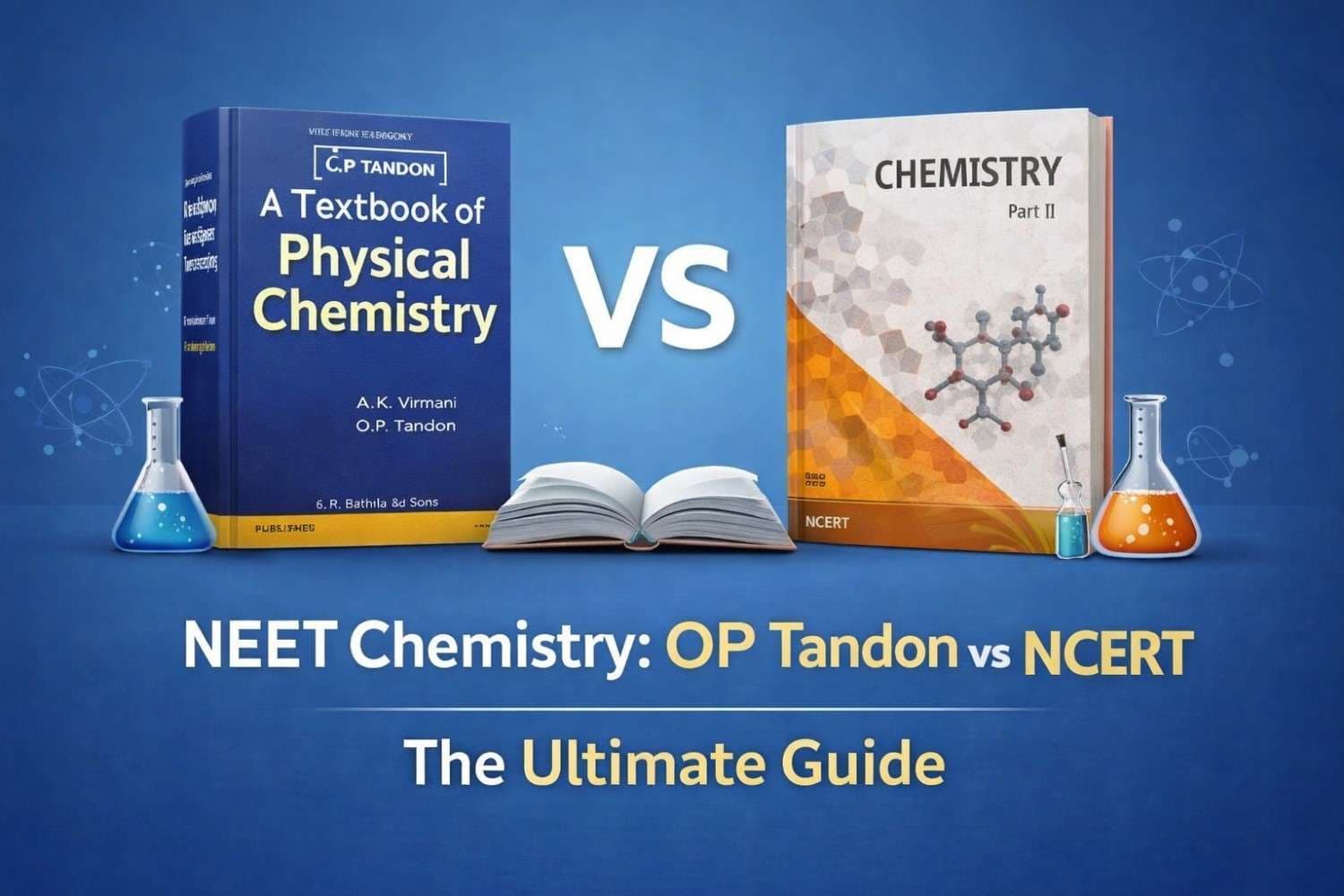
NEET Chemistry: OP Tandon vs NCERT - The Ultimate Guide
Table of Contents
Cracking the NEET exam requires a strategic approach to every subject, and Chemistry is no exception. With a vast syllabus and a mix of theoretical and numerical problems, choosing the right study material is crucial. Two popular choices for NEET Chemistry preparation are NCERT textbooks and OP Tandon's Objective Chemistry. But which one is better, or how should you use them?
NCERT: The Indispensable Foundation
The National Council of Educational Research and Training (NCERT) textbooks are often called the 'Bible' for NEET aspirants, and for good reason.
- Official Syllabus: NCERT books strictly adhere to the NEET syllabus, ensuring you cover all essential topics without wasting time on irrelevant ones.
- Conceptual Clarity: Written in a straightforward and easy-to-understand language, NCERT excels at building strong foundational concepts in Physics, Chemistry, and Biology.
- Direct Questions: A significant number of questions in the NEET exam, especially in Organic and Inorganic Chemistry, are directly lifted or closely based on NCERT text and examples.
- Cost-Effective & Accessible: They are affordable and readily available, often forming the core curriculum in schools.
- Essential for All: Every NEET aspirant, regardless of their current level, must master NCERT thoroughly.
However, NCERT does have limitations: It lacks the extensive problem practice and advanced conceptual depth required to tackle complex, application-based questions often found in NEET.
OP Tandon: The Comprehensive Practice Companion
OP Tandon's Objective Chemistry is a renowned reference book, especially popular among those aiming for competitive exams like NEET and JEE.
- Extensive Problem Bank: This book is a powerhouse of practice problems, ranging from basic to advanced levels, covering every topic comprehensively. This is its biggest strength.
- Advanced Concepts: It delves deeper into concepts than NCERT, providing a more detailed understanding and alternative approaches to problem-solving.
- Objective Questions: Designed specifically for objective-type exams, it helps students get accustomed to the format and time constraints of NEET.
- Problem-Solving Skills: Regular practice from OP Tandon significantly enhances problem-solving speed and accuracy.
On the flip side: OP Tandon can be overwhelming for beginners due to its sheer volume and sometimes includes topics slightly beyond the strict NEET syllabus. It's not ideal for building initial conceptual understanding if used as the primary source.
Which One for Whom?
- For Beginners/First-timers: Start with NCERT. Read it thoroughly, understand every concept, solve all in-text questions and exercises. Build a solid base first.
- For Those with a Strong Foundation: Once NCERT is mastered, move to OP Tandon for extensive practice. Use it to solidify concepts, improve speed, and tackle challenging problems.
- For Time-Constrained Students: Prioritize NCERT. If time permits, use OP Tandon selectively for specific weak areas or problem types (e.g., redox reactions, chemical kinetics numericals, organic reaction mechanisms).
The Synergistic Approach: NCERT + OP Tandon
The best strategy for NEET Chemistry is not an 'either/or' but a 'both' approach. Think of NCERT as your foundation and OP Tandon as your construction material to build a tall, strong building.
- Step 1: Master NCERT. Read each chapter multiple times, make short notes, understand all reactions, theories, and solved examples. Ensure you can answer all NCERT back-exercise questions confidently.
- Step 2: Practice from OP Tandon. After completing a chapter from NCERT, switch to the corresponding chapter in OP Tandon. Solve as many objective questions as possible. Pay attention to the variety of questions and try to understand the underlying principles.
- Step 3: Identify Gaps. If you struggle with certain topics in OP Tandon, revisit those sections in NCERT or seek additional clarification.
- Step 4: Regular Revision. Continuously revise both NCERT concepts and the types of problems encountered in OP Tandon.
Conclusion
NCERT provides the essential theoretical backbone and direct question potential for NEET Chemistry, while OP Tandon offers the crucial practice and depth needed to score high. By intelligently combining these two resources, you can build a robust preparation strategy that covers all bases and significantly boosts your chances of success in the NEET examination.