Mastering NEET: The Smart 'Tukka' Strategy for Higher Scores
Table of Contents
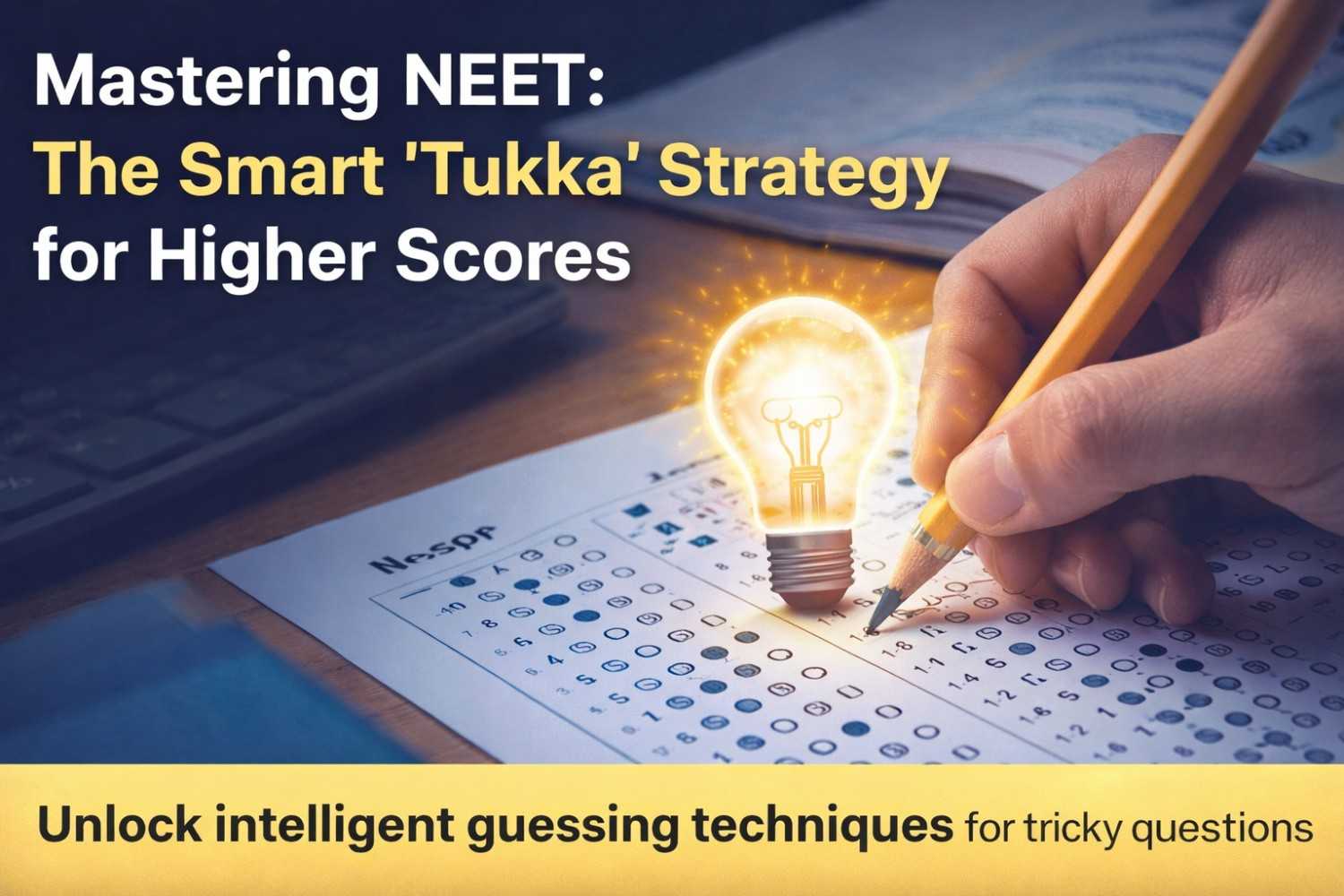
The word 'Tukka' often conjures images of blind guessing, a risky gamble in high-stakes exams like NEET. However, in the intense pressure cooker of competitive exams, intelligent risk-taking can be a powerful, score-boosting tool. This isn't about random guessing; it's about applying logical reasoning and strategic elimination to make an educated guess when you're not 100% sure of an answer.
NEET, with its negative marking scheme, demands precision. Skipping too many questions can lower your overall score, but blind guessing can be equally detrimental. This is where the 'Intelligent Tukka Strategy' comes into play – a method designed to tilt the odds in your favor.
When to Employ Intelligent Guessing
This strategy is not for every question. It's a calculated move to be used in specific scenarios:
- When you can eliminate at least two options: This is the golden rule. If you can confidently rule out two of the four choices, your probability of picking the correct answer jumps from 25% to 50%. This makes the risk-reward ratio highly favorable.
- Stuck between two options: This is the ideal scenario for an intelligent guess. You've narrowed it down, now apply further logic.
- Time Crunch with Many Unattempted Questions: Towards the end of the exam, if you have a significant number of questions left that you might otherwise skip, a quick, intelligent guess on a few where you have a slight inkling can fetch valuable marks.
Key Strategies for Intelligent Guessing
Here are some effective techniques to make your 'Tukka' intelligent:
1. The Elimination Method (Most Crucial)
This is the cornerstone. Systematically identify and rule out options that are clearly incorrect based on your knowledge. The more options you eliminate, the higher your chances.
2. Unit and Dimension Analysis (Physics & Chemistry)
For numerical problems, check the units of the options. If the question asks for velocity, and one option has units of acceleration, it's immediately wrong. Similarly, check dimensional consistency. This can quickly eliminate one or more choices.
3. Numerical Sanity Check (Physics & Chemistry)
Does the magnitude of the answer make sense? If you're calculating the speed of a car and one option is '5 x 10⁸ m/s' (faster than light), it's clearly incorrect. Similarly, if the calculation is about human body temperature and an option is 0°C, it's wrong. Use your common sense and approximate knowledge of physical quantities.
4. Look for the 'Odd One Out' or 'Similar Options'
- Odd One Out: Sometimes, three options might be similar in nature or structure, while one stands out. This 'odd one out' is sometimes the answer, or conversely, it's the distractor. Use caution.
- Similar Options: If two options are very close (e.g., 2.5 and 2.6), often one of them is the answer, or neither is and they're designed to trick you. If you've narrowed it down to these, there might be a subtle difference based on your conceptual understanding.
5. Extreme Values are Often Incorrect
Options containing words like 'always,' 'never,' 'all of the above,' or 'none of the above' (when others are specific) can be tricky. Extreme statements are often false in biological or scientific contexts unless proven universally true. Be cautious with these.
6. Most Comprehensive Option (Biology Specific)
In biology, if an option is more comprehensive or covers a broader aspect of a phenomenon, it sometimes tends to be correct, especially in 'select the best explanation' types of questions.
7. Grammar and Language Cues (Rare)
Occasionally, poorly constructed questions or options might give a hint. For instance, if one option uses more precise scientific terminology compared to vague ones, it might be the intended answer. However, this is a very subtle and unreliable strategy.
Risk vs. Reward: The Math
Let's consider the NEET marking scheme (+4 for correct, -1 for incorrect):
- Pure Guess (0 options eliminated): 25% chance of +4, 75% chance of -1. Expected value: (0.25 * 4) + (0.75 * -1) = 1 - 0.75 = +0.25. While mathematically slightly positive, the risk of losing marks is high. Generally NOT advised unless you are significantly behind and have nothing to lose.
- Eliminate 1 option (33.3% chance of correct): Expected value: (0.33 * 4) + (0.67 * -1) = 1.32 - 0.67 = +0.65. Worth considering.
- Eliminate 2 options (50% chance of correct): Expected value: (0.50 * 4) + (0.50 * -1) = 2 - 0.5 = +1.5. This is highly favorable and strongly recommended.
Practice Makes Perfect
Intelligent guessing is a skill, not a magic trick. The only way to hone it is through practice. During your mock tests:
- Consciously try to eliminate options even for questions you're unsure about.
- Analyze which strategies worked and which didn't.
- Track the accuracy of your educated guesses to understand your personal success rate.
Conclusion
Intelligent 'Tukka' is a supplementary strategy, not a replacement for thorough preparation. Your primary focus must always be on conceptual clarity, strong knowledge base, and effective time management. However, when faced with uncertainty, applying these intelligent guessing techniques can significantly improve your chances of gaining those crucial extra marks, potentially making the difference between success and failure in NEET. Use it wisely, practice diligently, and approach your exam with confidence and strategy.