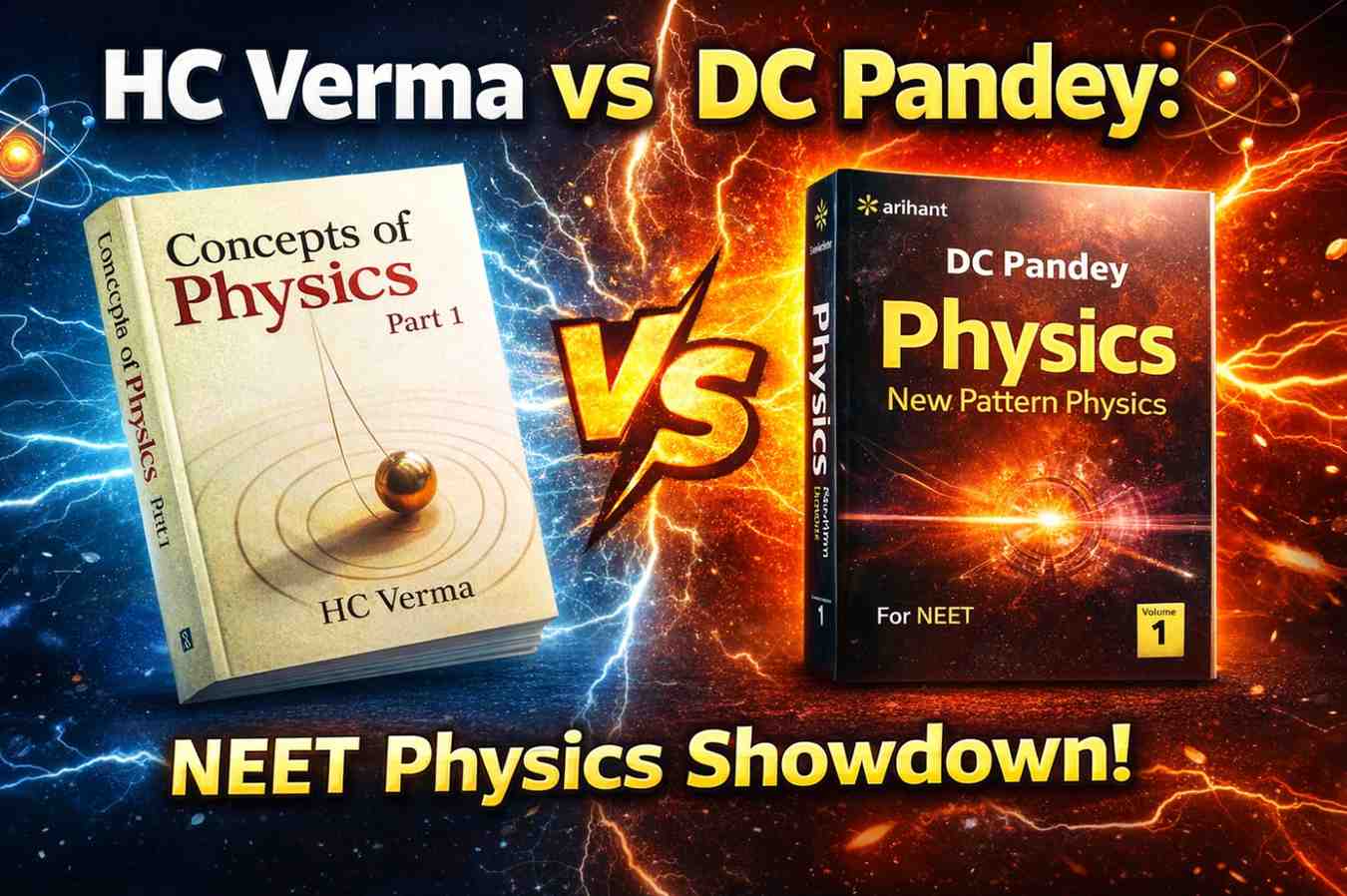
HC Verma vs DC Pandey: NEET Physics Showdown!
Table of Contents
When it comes to NEET Physics preparation, two names frequently echo in the minds of aspirants: H.C. Verma's 'Concepts of Physics' and D.C. Pandey's 'Objective Physics for NEET'. Both are highly regarded, but they cater to slightly different needs and approaches. Choosing the right one, or understanding how to use both effectively, can significantly impact your score. Let's break down their strengths, weaknesses, and ideal use cases.
H.C. Verma: The Conceptual Maestro
H.C. Verma's 'Concepts of Physics' is a legendary two-volume set renowned for its in-depth theoretical explanations and robust problem-solving approach. While not explicitly designed for NEET (it's often associated with JEE Advanced), its profound conceptual clarity makes it invaluable.
- Strengths:Unparalleled Conceptual Clarity: Verma Sir's explanations are lucid, building concepts from the ground up, ensuring a strong foundational understanding.
- Thought-Provoking Problems: The objective and subjective problems are designed to challenge your understanding and encourage critical thinking, going beyond rote memorization.
- Developing Problem-Solving Skills: Working through HC Verma problems hones your ability to approach complex physics questions logically.
- Strong Foundation for Advanced Topics: If you aim for a deep understanding of physics, this book is a must.
- Weaknesses:Not Strictly NEET-Oriented: Many problems, especially in the subjective section, might be beyond the scope or difficulty level required for NEET.
- Time-Consuming: Covering all problems can be very time-consuming, potentially diverting focus from other subjects or NEET-specific practice.
- Lack of NEET-Specific Question Types: It doesn't focus on the MCQ format with specific options like NEET does.
D.C. Pandey: The NEET Specialist
D.C. Pandey's 'Objective Physics for NEET' (published by Arihant) is tailor-made for the NEET examination. It aims to provide comprehensive coverage of the NEET syllabus with a strong emphasis on objective-type questions.
- Strengths:NEET-Specific Content: The book strictly adheres to the NEET syllabus and exam pattern, ensuring relevant coverage.
- Extensive Objective Problems: It offers a vast bank of MCQs, including single-correct-option and assertion-reason types, crucial for NEET practice.
- Categorized Questions: Problems are often categorized by difficulty level or topic, making targeted practice easier.
- Previous Year Questions (PYQs): Includes a good collection of past NEET/AIPMT questions, essential for understanding exam trends.
- Concise Theory: The theory sections are typically concise and to the point, focused on exam utility.
- Weaknesses:Less Conceptual Depth: While theory is covered, it might not offer the same profound conceptual build-up as HC Verma. Students might need external sources for deeper understanding if they struggle.
- Focus on Quantity over Quality (sometimes): While it has many problems, some might find the conceptual challenge less rigorous than HC Verma.
Which One to Choose? Or Both?
The optimal choice often depends on your current understanding of physics and your preparation strategy.
Scenario 1: Building a Strong Foundation (Beginner to Intermediate)
If your physics fundamentals are weak or you're starting fresh, prioritize H.C. Verma for theory and solved examples. Focus on understanding the concepts thoroughly and solving the objective questions (short answers, multiple choice with one correct option) and some subjective problems from each chapter. Don't get bogged down by the most challenging subjective problems if time is a constraint. Once you feel confident with the concepts, switch to D.C. Pandey for extensive NEET-specific MCQ practice.
Scenario 2: Already Have Strong Concepts (Intermediate to Advanced)
If you have a good grasp of physics concepts, you can use D.C. Pandey as your primary book for practice. Use its theory sections for quick revision and then dive deep into the vast array of MCQs. You can refer to HC Verma for clarification on any specific concept you find challenging in D.C. Pandey or if you want to solve some higher-level problems for extra challenge.
The Ideal Approach: A Hybrid Strategy
Many toppers advocate a combined approach:
- Conceptual Mastery: Use HC Verma for in-depth understanding of theory. Read chapters thoroughly, solve all objective 1, objective 2, and a selection of subjective problems (especially those marked with an asterisk or deemed fundamental).
- NEET-Specific Practice: Supplement this with D.C. Pandey for extensive practice of NEET-level MCQs. This is where you apply your conceptual knowledge in the exam format, focus on speed, and learn time management. Solve all previous year questions from D.C. Pandey.
- Revision: Use D.C. Pandey's concise theory or your self-made notes for quick revisions before tests.
Conclusion
Both H.C. Verma and D.C. Pandey are excellent resources for NEET Physics, but they serve different purposes. HC Verma builds your conceptual bedrock and problem-solving muscle, while D.C. Pandey fine-tunes your skills for the specific demands of the NEET exam. For the best results, consider a strategic blend of both – building strong concepts with Verma and perfecting your objective problem-solving with Pandey. Happy studying, and may your NEET journey be successful!